
Deconstructing the Corporate Pyramid
Internal fighting while looking for external solutions


The first time I dug into Prototype Thinking, I did so to proofread some copy for my friend J Li. This’ll be interesting, I thought, but not something I’ll truly understand. I’d already listened to my partner teach entrepreneurial classes and talk about methodology with his friends. I recognized several terms, but I couldn’t define them. Yet, despite my time in various companies, being on the outside looking in was nothing new for me.
Corporate Life vs. My Life
For years, I’d felt left behind by the realm of corporate culture, confused by the norms. I feared I was too artistic to ever find the rigidity of the traditional working space helpful to me.
It’s fair to say I carry a lot of corporate trauma with me. In my first job out of college, my manager regularly timed my bathroom breaks and called me stupid in front of customers. Twelve to sixteen hour days were not just expected; we needed to be working with a smile, to prove we were a “team player,” happy to ignore our families and friends who waited for us at home.
When I moved into a position as a graphic designer at a small company of 40 or so people (and away from the abusive manager), I basically thought I was in heaven and had no right to complain regarding the things that frustrated me. Even if those things could’ve been solved with a new approach.
The Digital Age of Real Estate

The company was a listing service in the digital age. Once upon a time, listing services would print physical booklets filled with all the houses that were for sale, and other real estate agents would use these tomes to find properties for their clients to purchase. Nowadays, things moved too fast for the books to be relevant; by the time they had been printed, the house would’ve sold.
But the core of the business was the same: we connected agents of sellers to agents of buyers. How we did that was offering software.
Anyone who has searched for a property to rent or buy has likely felt the sting of realizing, despite what a certain website said, the house had already sold or been rented. Our software not only compiled properties alongside all the most important data, it updated their status in real time.
But offering that software required us to consider the lives of our customers–the real estate agents–and how they input and updated their listings, how they added the required paperwork, and how they closed houses in the digital space.
It made the user experience of our software very important. Anything that complicated the process would slow down the buying and selling of houses, reflecting negatively on the real estate agent, and anything that confused or frustrated the agents would increase calls to our customer care center, requiring more employees to work at a hurried pace.
So how did we decide the UX of our software? We gathered people together from each section of what I call the corporate pyramid.
The Traditional Corporate Pyramid
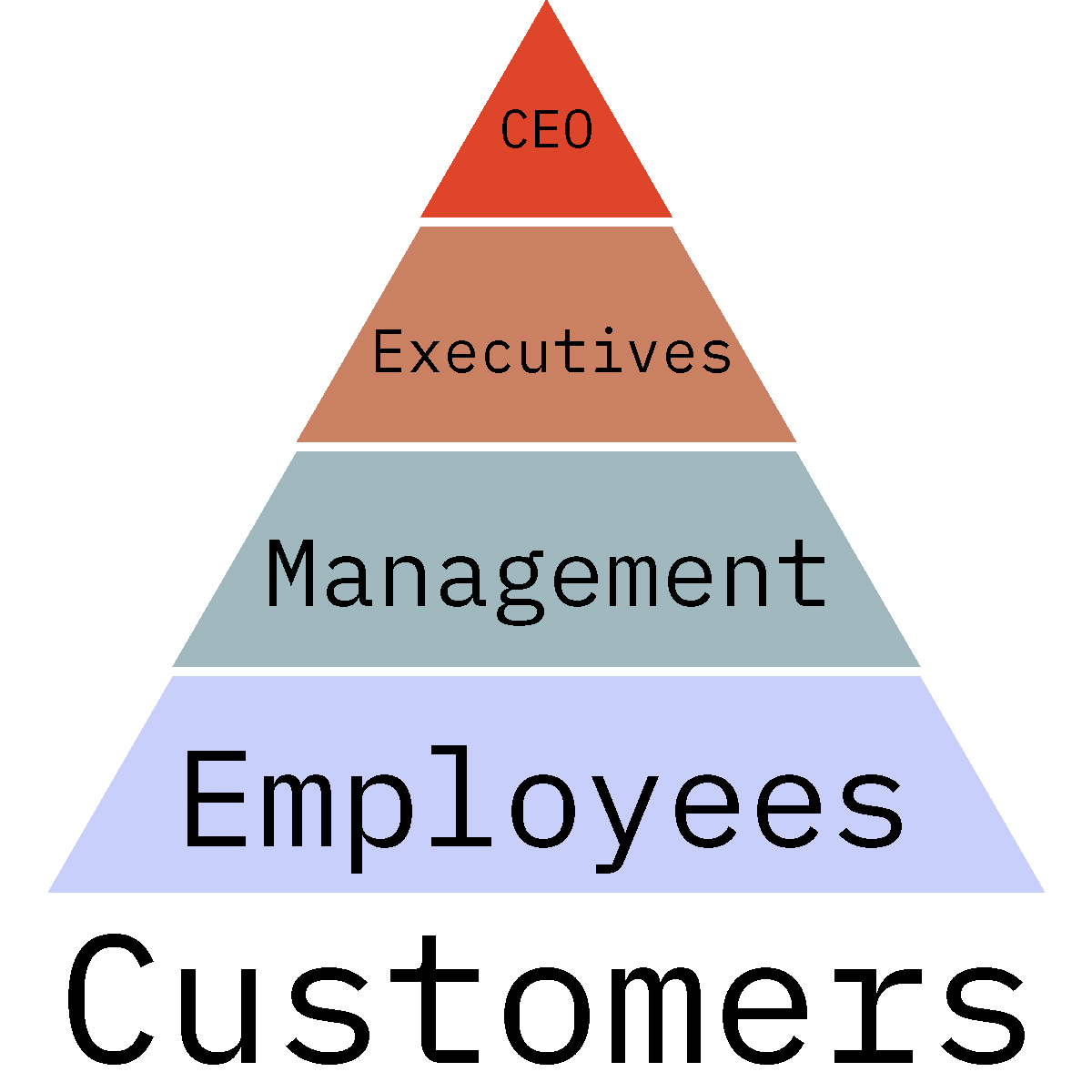
I think everyone who has worked in a corporation has seen something like this. It’s the traditional setup for how companies work where new ideas and changes filter from the top to the bottom, before making their way to the customers who reside outside of the pyramid. It’s a system of being told how things will work, as opposed to asking how they should work.
In many businesses, including the one I worked at, even UX was decided this way. Once we had a few people from each section in one room, we’d discuss the upcoming changes and how they’d be implemented. There was a level of feedback involved, but anyone who has worked in a situation like this can guess how this brainstorming went.
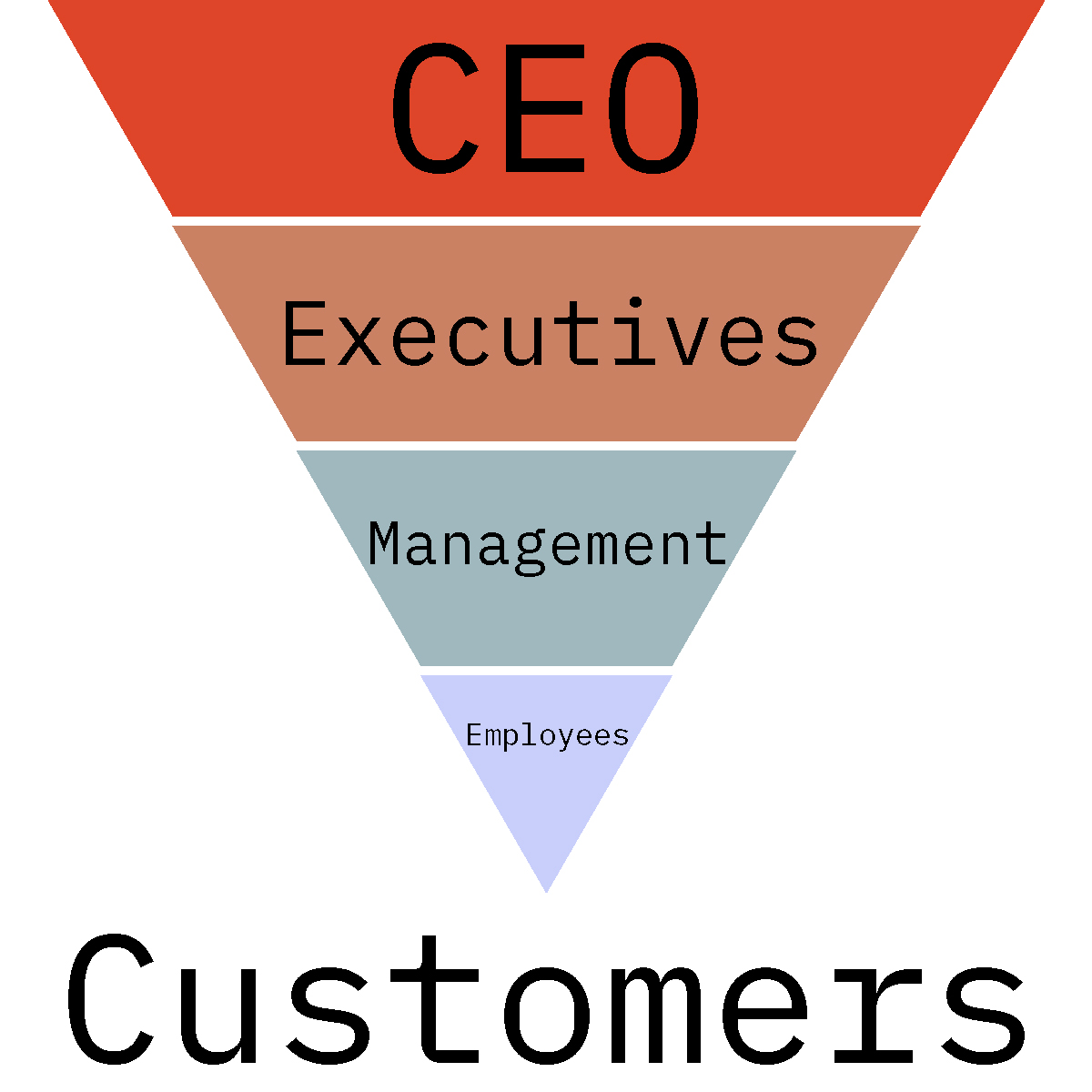
Immediately, each person’s role took on a certain weight based on their title. The pyramid began to look like this:
Fighting Against a Higher Weight Class
With this setup, the CEO wasn’t just the most powerful person at the company; they became the person in the room, the one whose ideas had to be accepted regardless of how that affected the customers. Executives, who dealt mostly in hypotheticals, focused on the real estate market, while management considered what was attractive, favoring form over function.
Despite it being the average employee in customer service who spoke the most with the real estate agents–our customers–their opinions were valued the least.
How did that end? Well, exactly as you’d expect. Changes were made to the software without ever consulting the customer, resulting in things that were confusing or frustrating. Calls to the customer care center would increase. Employees would be forced to work at break-neck speeds to answer all the incoming calls.
People began to dread update days, just as many of those involved in the update meetings began to feel they were a waste of time.
I personally hated them. There was no sense of co-creation, and I know, speaking with some of my fellow employees, I certainly wasn’t the only one who walked away from those meetings with a resigned feeling of, “Well, this is just how it’s going to be, and we’ll all have to accept that.”
I didn’t understand why I had to sit in a room to listen to a group of Yes Men praise ideas based on someone’s rank in the company. To me, it could’ve been summed up in an email titled, “This is What We’re Doing.” Yet I never imagined a different way of doing things, and eventually, I parted from the company to pursue more artistic endeavors.
Things Could’ve Been Easier
Going through the copy J Li had sent me, I didn’t just understand Prototype Thinking; I had a moment like the galaxy brain meme. “This would’ve fixed everything,” I told myself. If I had a time machine, I would’ve immediately taken the Prototype Thinking methodology to my coworkers and pushed for adoption.
It was the thing I had so desired without ever having the words for it. The user was considered at every step of the production phase. Rapid prototypes were developed to test directly with those users.
Why guess at what a user will do, when you could know with absolute certainty? And why change the software, only to find it’s frustrated, confused, and alienated many of the users, leading to more calls to the customer care center and overwhelmed, overworked employees?
I immediately saw the weaknesses of the traditional method of updating our software, and why I’d been so frustrated in those corporate meetings all those years ago. We’d been taking shots in the dark, prioritizing our own experience, as opposed to the customers’.
Remember the pyramids? Prototype Thinking would change the room so it would look more like this:
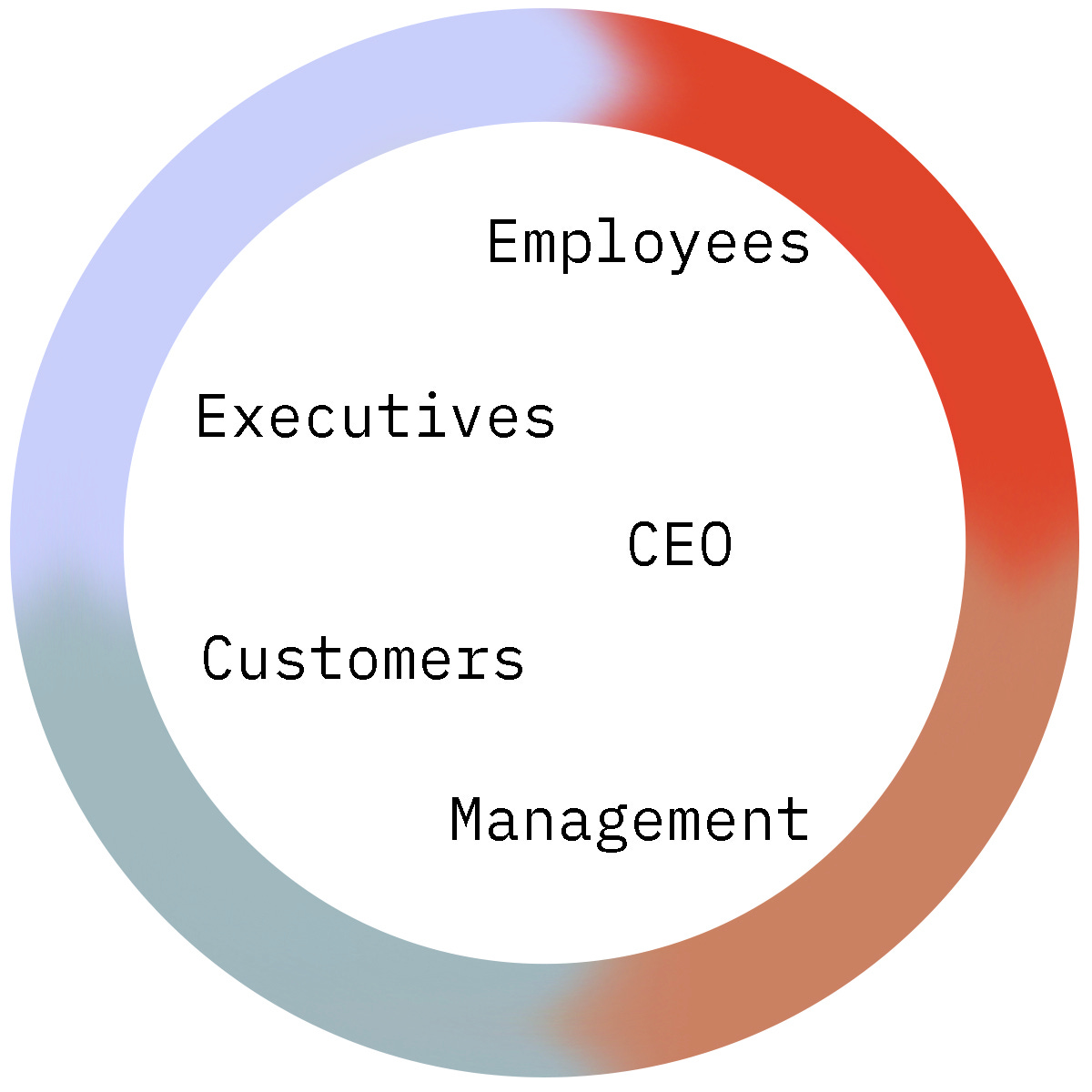
Now everyone–from the CEO to the average customer service employee–would work together with an outward focus on the user, as opposed to battling against the corporate pyramid and the weight their roles carried within the company. And customers would be included in the process!
The more I thought about it, the more I realized just how much Prototype Thinking could fix in the traditional corporate framework:
No more fighting for internal buyin
No frustrating meetings
Pivots wouldn’t be expensive
No more months or years of development hell
Experimenting would result in rapid changes, while confusing and frustrating features would be streamlined or cut
Which all would lead to happier customers and less calls to the customer care center.
But the wildest realization of all: Maybe if I’d had Prototype Thinking all those years ago, I wouldn’t have left the company with such a sour taste in my mouth.